

Rank #1
- Available points earned
- 33.6% 10,650 pts
- Times picked #1
- 109
- Sources awarding points
- 109
Top game that year
How this year's score was calculated
See the sources used to calculate this year's ranking, including each source's name and type.
We have checked every source and possible result we found. Nothing is currently waiting for review.
See each source's name and type, who made the selection, and how its points were calculated.
| Rank | Game | Available points earned | Times picked #1 | Sources awarding points |
|---|---|---|---|---|
| #1 | 33.6% 10,650 pts | 109 | 109 | |
| #2 | 13.1% 4,150 pts | 42 | 42 | |
| #3 | 7.3% 2,300 pts | 23 | 23 | |
| #4 | 6.9% 2,200 pts | 22 | 22 | |
| #5 | 5.4% 1,700 pts | 18 | 18 | |
| #5 | 5.4% 1,700 pts | 17 | 17 | |
| #7 | 4.7% 1,500 pts | 16 | 16 | |
| #8 | 4.4% 1,400 pts | 14 | 14 | |
| #9 | 3.8% 1,200 pts | 12 | 12 | |
| #10 | 1.9% 600 pts | 6 | 6 | |
| #11 | 0.9% 300 pts | 3 | 3 | |
| #12 | 0.8% 250 pts | 3 | 3 | |
| #13 | 0.6% 200 pts | 2 | 2 | |
| #13 | 0.6% 200 pts | 2 | 2 | |
| #13 | 0.6% 200 pts | 2 | 2 | |
| #13 | 0.6% 200 pts | 2 | 2 | |
| #17 | 0.3% 100 pts | 1 | 1 | |
| #17 | 0.3% 100 pts | 1 | 1 | |
| #17 | 0.3% 100 pts | 1 | 1 |
2014 Retrospective
No 2014 game came close to winning half of all selections. Dragon Age: Inquisition placed large regions around BioWare's companions and choices. The two approaches did not always fit, but together they showed the most promise.
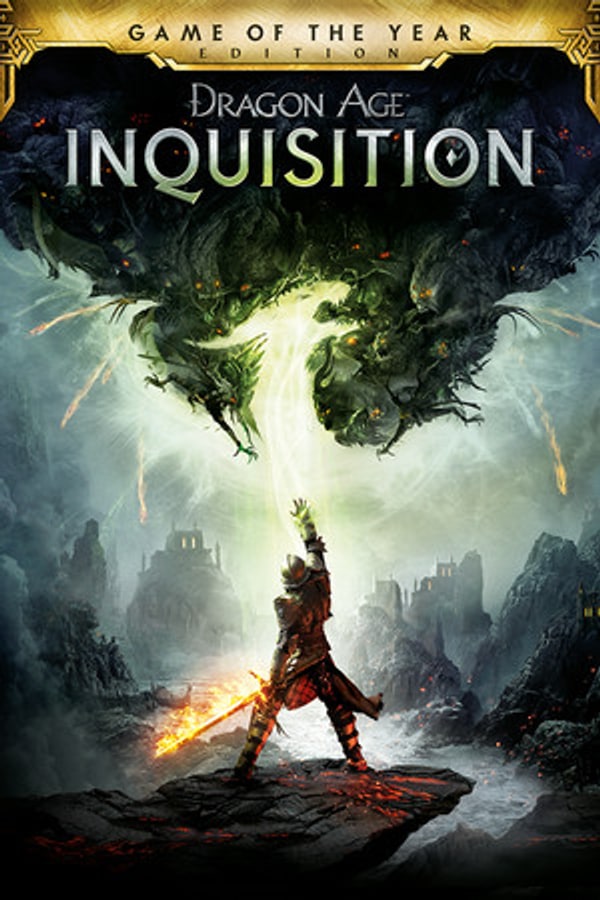
Dragon Age: Inquisition led with 109 of 317 first-place selections, or 33.6%. Middle-earth: Shadow of Mordor followed with 42, or 13.1%. The gap was large, but one third of the tally was hardly a consensus. Voters most often favored a game that combined several strengths.
This game combines two types of RPGs. The companionship and dialogue choices that BioWare excels at are at the center. Activities such as large areas, gathering materials, and occupying bases were added to this. GameSpot praised the large world and consequences of choices. The production team also explained that the balance between free exploration and the central story was important. [1] [2]
This combination captured the problem facing large RPGs at the time. A fixed path could make a game feel small, but a wide map alone could erase BioWare's identity. Inquisition included both. That made it rich, but the amount of work could also become tiring.
There is a lot to do in the Hinterland at the beginning of the game. There are quests, rifts, collectibles, and campsites scattered throughout. Even if you forget the central story and just wander around the area, it will take a long time. The Guardian also praised the range of activities, while warning that many minor errands were better skipped. [3]
PCWorld was more critical. It argued that the large world weakened BioWare's storytelling and made many quests feel like boxes on a checklist rather than personal conflicts. A game can offer plenty to do and still feel thin when those tasks lack a strong reason. [4]
At the time, that abundance was also an advantage. The game showed the scale and scenery that new consoles could deliver. Its regions brought players into conflicts over religion, power, and race. Many activities now look unnecessary, but in 2014 they also showed how large an RPG could become.
The reason Inquisition is not buried in repetitive activities is thanks to its companions. The inquisition brings together people with different thoughts and pasts. Players don't just choose which companions to take into battle. You choose whose trust you will gain and which faction you will support.
Creative director Mike Laidlaw said choices were not meant to be simple good-or-evil buttons. They were a way for players to define their own Inquisitor. Not every decision changed the whole world, but a companion's reaction could make it personally important. [5]
The most memorable moments often happened at the base rather than in the open fields. Conversations with companions and difficult judgments preserved the game's identity. The open world expanded the playtime, but characters and choices kept BioWare's strengths intact.
The Game Awards and D.I.C.E. Awards chose Dragon Age: Inquisition, while BAFTA chose Destiny. Inquisition expanded a character-driven RPG into broad regions. Destiny joined shooting to long-term online progression. Neither was flawless, but both suggested where large games might go next. [6] [7] [8]
Inquisition's 109 first-place selections include 72 editorial, 26 reader, 4 industry, and 7 mixed. Its support crossed several groups without dominating any one of them. It was the most common choice, not a unanimous one.
This was not a complete victory that changed RPG history. Inquisition was a transitional open-world RPG: it showed what the genre could add but not what it needed to remove. That weakness helps explain why The Witcher 3 stood out so clearly the following year.